styleFon jerng
ฟ้อนเจิง · fon choeng
Thai Wikipedia's history of the sport starts it here, in Lanna, as a dance.
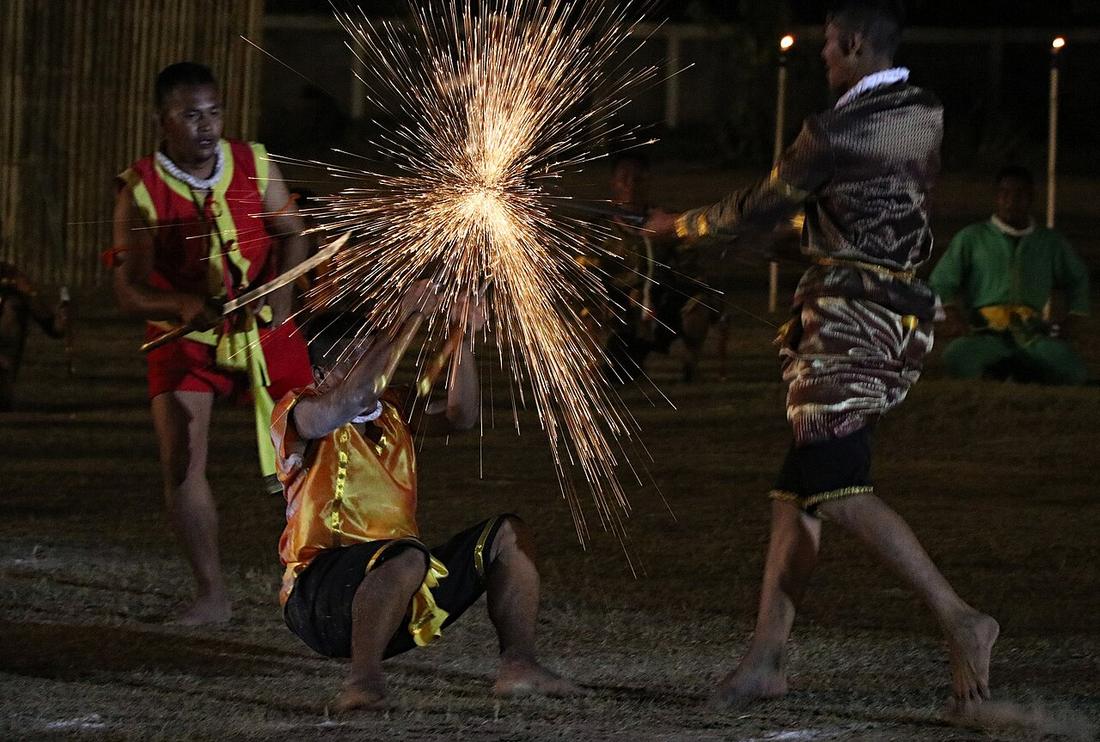 Arjarn Sira · CC BY-SA 4.0
What it is
The Lanna martial dance. Jerng means tactics or finesse; fon is to dance. It is performed with weapons and with empty hands, and the Thai-language history of muay thai names it as the origin of the craft.
The long version
The sentence is unambiguous in Thai: วิชามวยไทยจึงมีจุดเริ่มต้นมาจากวิชาเจิง — the craft of muay thai therefore begins from the craft of jerng.
It comes in forms named for what is in the hand. ฟ้อนเจิงหอก with a spear, ฟ้อนเจิงดาบ with a sword, ฟ้อนเจิงลา with nothing at all. The empty-hand form is the one that matters here: a set of movements held as a dance, performed at festivals, which is also a fighting syllabus.
Inference — that is a different relationship between dance and fighting from the one the ram muay has. A ram muay is a ceremony attached to a fight. Fon jerng is the fighting, kept as a dance — which is how a syllabus survives in a place with no standing school and no printed manual.
The English article carries the same claim in a weaker form, dating the training of muay thai from the movements of fon jerng and noting that it survives as a recreational dance in the north today.
Connected to
- Lanna Where it is from.
- The victory drum What is played over it.
- Top maphap The part with no weapon and no opponent.
- Manop Yarana Who taught it, for fifty years.
- The hermit's school The older claim underneath it.
- The dance before the fight The other dance, and a different relationship.
Named here by
- Top maphap The dance it belongs to.
- The victory drum What it is played over.
- Manop Yarana What he taught.
- Lanna The dance.
Where each claim comes from
| Field | Tier | Source | Note |
|---|---|---|---|
| default | cited | ประวัติศาสตร์มวยไทย — Wikipedia (th) | |
| text_th | inference | written in Thai by this project, not machine-translated |
Sources
- ประวัติศาสตร์มวยไทย — Wikipedia (th)
- Muay Thai — Wikipedia (en)
- นาฏศิลป์ล้านนา — Wikipedia (th)
cited Cited — a named source, linked · harvested Harvested — fetched from an open dataset, with its licence · tradition Tradition — general knowledge of the tradition, hedged · inference Inference — this project's own reasoning from the above · field Field — someone stood there