ritualThe dance before the fight
ไหว้ครูรำมวย · wai khru ram muay
Four minutes of not fighting, and it is not a warm-up.
 Kru Tony Moore · CC BY-SA 4.0
What it is
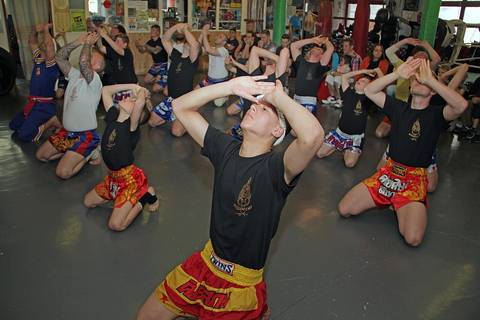
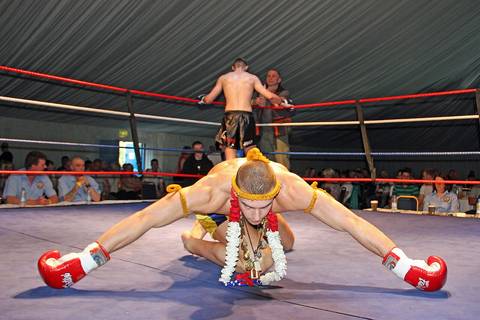
Two halves. Wai khru is paying respect to the teacher — kneeling, bowing three times toward the corner. Ram muay is the dance that follows, which is the fighter's own and belongs to his gym.
The long version
Wai khru is not a boxing ritual. The Thai article on it lists the same ceremony for school teachers, for shadow puppetry, for krabi-krabong, and for writing poetry: the form belongs to apprenticeship in general, and boxing is one of its borrowers.
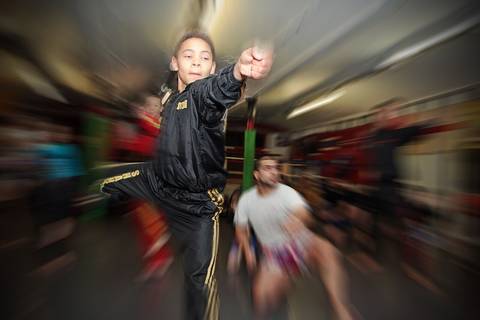
What the fighter is doing in the second half is more specific. A ram muay is taught, it is a gym's signature, and a Thai watching can often name the camp from it. It also tells the other corner something: a man who takes his time in the dance is making a statement about his own composure while the other man stands there in the cold.
Inference — the reason the ceremony survived professionalisation intact, when the rope, the bare feet and the open-weight matchmaking all went, is that it costs the promoter nothing and fills four minutes of a television slot.
Connected to
- The mongkhon Worn through it, and taken off at the end.
- The band What is played under it.
- The armbands The other thing tied on.
- Reading a ram muay How to read one from the seats.
Named here by
- Fon jerng The other dance, and a different relationship.
- The rules that come with it The same two words, in the ring.
- The mongkhon When it comes off.
- The band What it opens under.
- What an evening is shaped like The four minutes.
- khru The ceremony.
- Reading a ram muay The ceremony.
Where each claim comes from
| Field | Tier | Source | Note |
|---|---|---|---|
| default | cited | พิธีไหว้ครู — Wikipedia (th) | |
| text_th | inference | written in Thai by this project, not machine-translated |
Sources
- พิธีไหว้ครู — Wikipedia (th)
- Muay Thai — Wikipedia (en)
cited Cited — a named source, linked · harvested Harvested — fetched from an open dataset, with its licence · tradition Tradition — general knowledge of the tradition, hedged · inference Inference — this project's own reasoning from the above · field Field — someone stood there