ritualSak yant
สักยันต์ · sak yan
Prick the skin, hold the power. The ink is a device, not a picture.
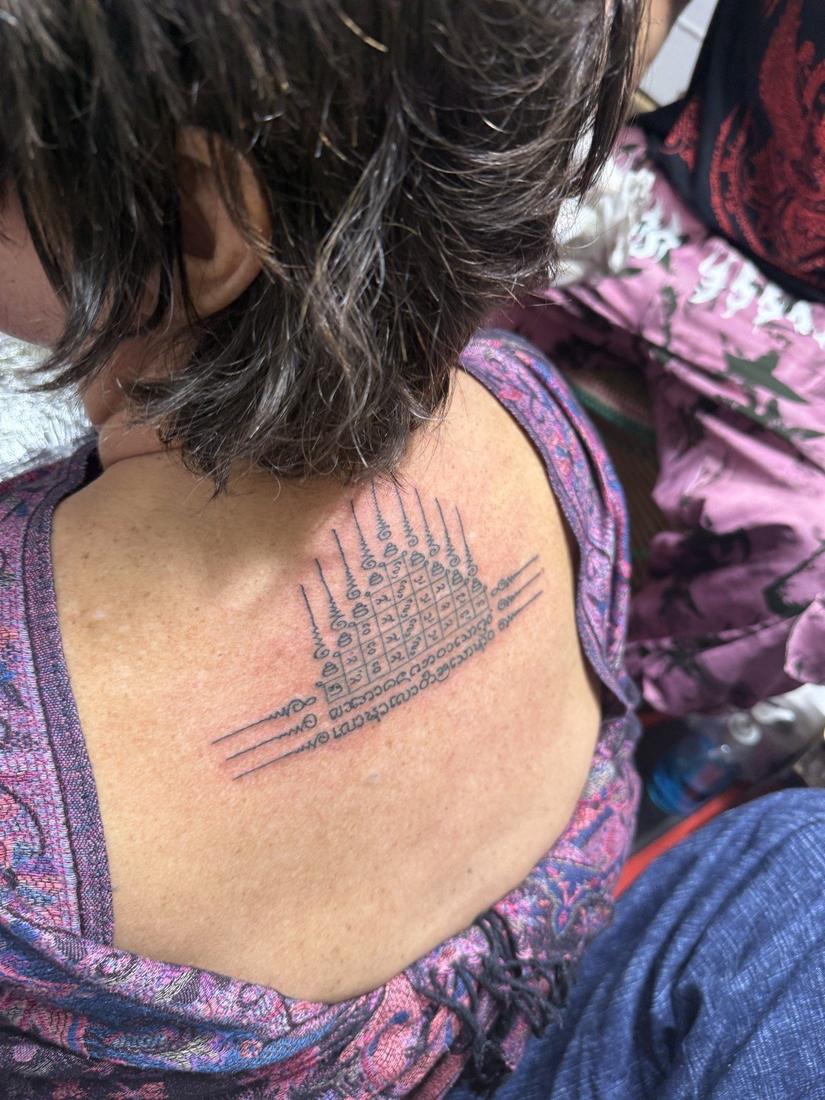 NaN · Taken at Sak Yant Chiang Mai, used with permission · CC BY 4.0
What it is
A tattoo that is a working object: geometry and syllables in an old script, applied by a master, carrying protection, fortune, charisma or fear — and conditional on rules the bearer keeps afterwards.
The long version
Where it comes from. The practice is dated to the Khmer Empire around the ninth century, resting on Mainland Southeast Asian animist tattooing that goes back far further, with the geometry taken from Indian yantras. It is Cambodian, Lao, Thai and Burmese, and it does not belong to one of them.
What the script tells you. There is no single alphabet for this. In Cambodia, Khmer script. In central Thailand, Khom — the Khmer-derived script used there for Pali and for anything sacred. In the north the yant is written in northern Thai, Shan or Tai Lu script, and in Laos in Lao Tham. A yant done in Chiang Mai and a yant done in Nakhon Pathom are not written in the same letters. The alphabet on a person's back is a map of where their master's lineage is from, and it is the first thing to read.
Three kinds of effect, in the article's own division: what benefits the bearer — eloquence, charm; what protects — warding off harm, which is why it is carried by soldiers, police, taxi drivers and anyone whose work is dangerous; and what acts on other people, including invoking fear.
And it is conditional. The power holds only while the bearer keeps the rules and the taboos that came with it, which can include abstaining from a particular food. It also fades with time, which is why masters re-empower their disciples' tattoos once a year at Wai Khru.
In this sport. A fighter's whole ritual kit is the same practice in different materials: the mongkhon blessed by a monk, the prajiat tied round the arm, the takrut rolled in metal, and the yant under the shirt. They carry the same syllables, from the same masters, for the same reasons. The difference is only whether the surface can be taken off.
How
The word. Sak (สัก) is to prick, a native Khmer word from a Mon-Khmer root cɔkʔ, to prick — not a Sanskrit loan. Yant is yantra (यन्त्र), from Sanskrit yam, to hold or sustain, plus tra*, an instrument. A yantra is an instrument for holding something in place. The name says exactly what the thing is meant to do.
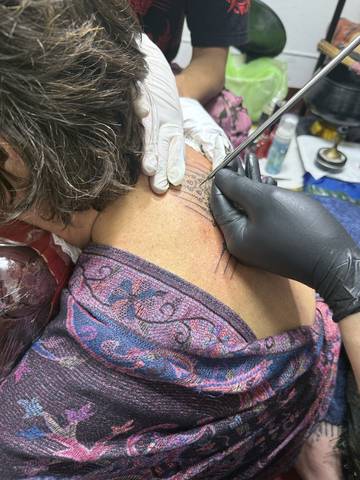
The needle. A khem sak about eighteen inches long and four millimetres wide, the tip split so each strike puts down two dots. A typical design takes about three thousand strikes. The needle is dipped every thirty seconds into a mix of oil, Chinese charcoal ink, and — the account says possibly — snake venom.
The finish. When the drawing is done the master blesses it and blows a kata onto it, and that is the step that makes it work. The ink without the breath is a drawing.
Notes
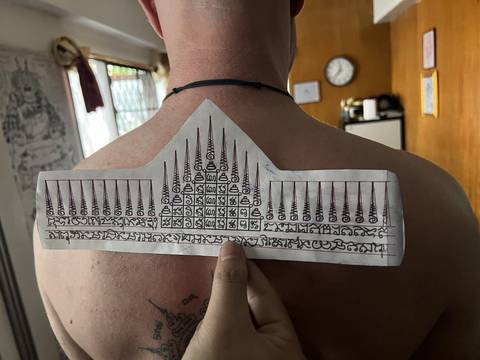
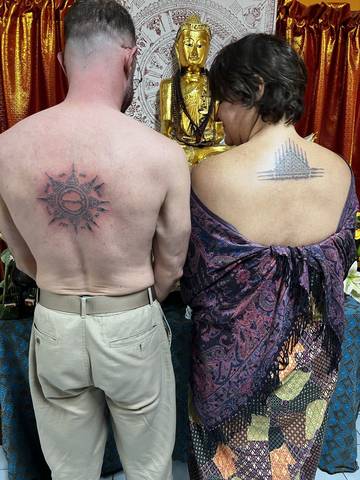
The photographs on this page and on the pages for gao yod and the rules were taken at Sak Yant Chiang Mai, where the ajarns welcome photography, and are used with their permission. They are published CC BY 4.0 like everything else here.
Connected to
- Wat Bang Phra The one outsiders have heard of.
- Gao yod, the nine spires The first one, almost always.
- Suea phen, the leaping tiger The one fighters are known for.
- Khom, and the scripts it is not The central Thai script for it. The north uses its own.
- The rules that come with it What keeps it working.
- Takrut The same thing, in metal.
- The mongkhon The same thing, on cord.
- The armbands The same thing, on cloth.
Named here by
- Gao yod, the nine spires The practice.
- The rules that come with it The practice.
- The mongkhon The one that cannot be taken off.
- The armbands The same yantra, on skin.
- Suea phen, the leaping tiger The practice.
- Wat Bang Phra The practice.
- Takrut The same thing on skin.
- Khom, and the scripts it is not What it writes.
Where each claim comes from
| Field | Tier | Source | Note |
|---|---|---|---|
| default | cited | Yantra tattooing — Wikipedia (en) | |
| text_th | inference | written in Thai by this project, not machine-translated |
Sources
- Yantra tattooing — Wikipedia (en)
- Wat Bang Phra — Wikipedia (en)
- Khom Thai script — Wikipedia (en)
- Tai Tham script — Wikipedia (en)
cited Cited — a named source, linked · harvested Harvested — fetched from an open dataset, with its licence · tradition Tradition — general knowledge of the tradition, hedged · inference Inference — this project's own reasoning from the above · field Field — someone stood there