artThe epic in the technique list
รามเกียรติ์ในสังเวียน · ramakian nai sangwian
Fourteen of the thirty named techniques come out of one story cycle.
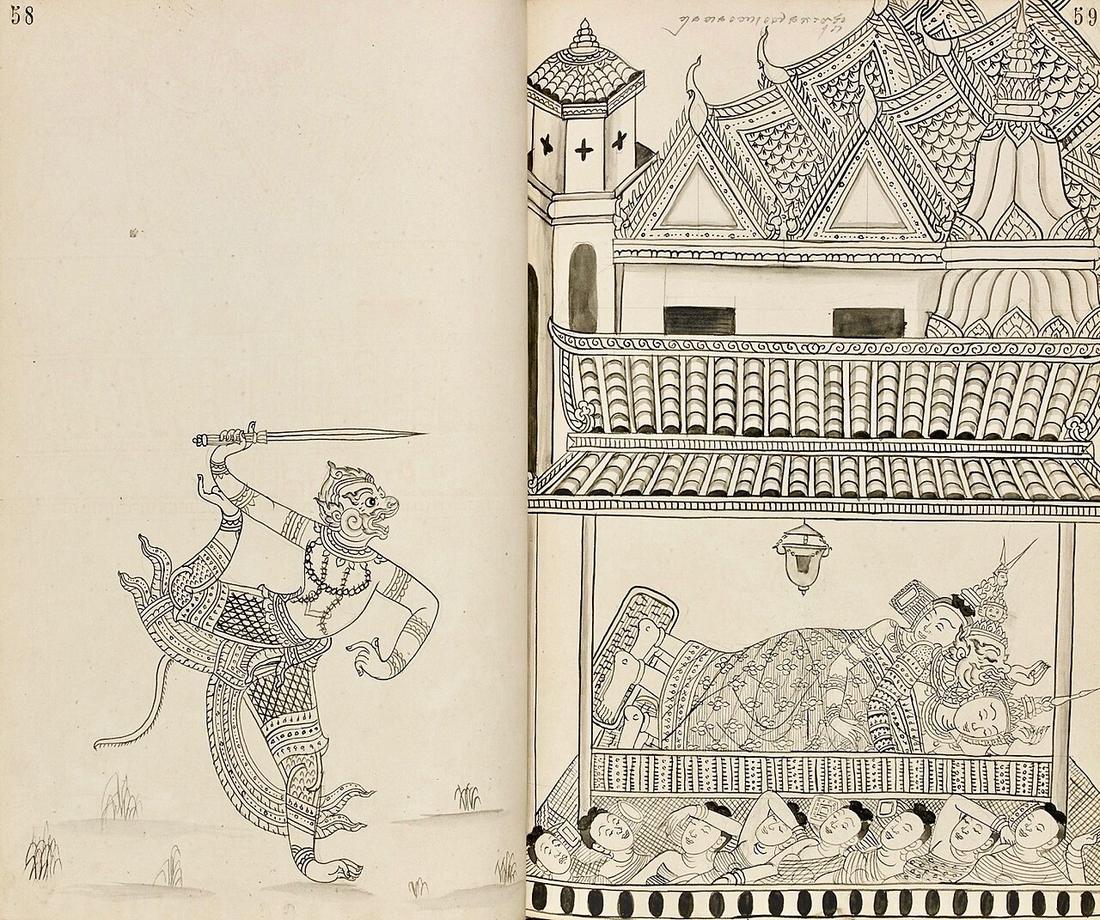 Ms Sarah Welch · CC BY-SA 4.0
What it is
The Ramakien — the Thai telling of the Ramayana — supplies the cast of the curriculum: Rama, Hanuman, Thotsakan, Sida, Erawan, the nagas, the kumbhanda, Hiranyaksha.
The long version
Counted off the two lists of fifteen: fourteen of the thirty name a figure from the epic or its Hindu antecedents, six name a person by their trade or their people, five name an object or a household job, four name an ordinary animal, and one names the movement.
Lopburi's school list is more concentrated still: five of six.
Inference — the Ramakien was the state's own narrative property — painted round the cloister at Wat Phra Kaew, performed as khon at court, versified by Rama I and Rama II. A technique list built out of it is not folk memory. It is a curriculum written by people who had that wall in front of them.
And it is why the names cannot be translated into instructions. Hanuman presents the ring is not a description of two fists going up. It is a pointer at a scene everybody in the room had seen painted.
Connected to
- The fifteen mother techniques The first list.
- The fifteen that come after The second.
- Hanuman presents the ring The scene.
- Muay Lopburi Five of six.
Named here by
- Breaking Erawan's neck Whose elephant.
- Hanuman presents the ring The scene it comes from.
- The fifteen that come after The cast list.
- The fifteen mother techniques Where half the names come from.
- Muay Lopburi Which its list is almost entirely made of.
Where each claim comes from
| Field | Tier | Source | Note |
|---|---|---|---|
| default | inference | แม่ไม้มวยไทย — the fifteen and the fifteen, at revision 13177866 — Wikipedia (th) | |
| text_th | inference | written in Thai by this project, not machine-translated |
Sources
- รามเกียรติ์ — Wikipedia (th)
- แม่ไม้มวยไทย — the fifteen and the fifteen, at revision 13177866 — Wikipedia (th)
cited Cited — a named source, linked · harvested Harvested — fetched from an open dataset, with its licence · tradition Tradition — general knowledge of the tradition, hedged · inference Inference — this project's own reasoning from the above · field Field — someone stood there