ruleHow a fight is actually scored
การให้คะแนน · kan hai khanaen
The whole fight is one thing. Round one is not worth winning.
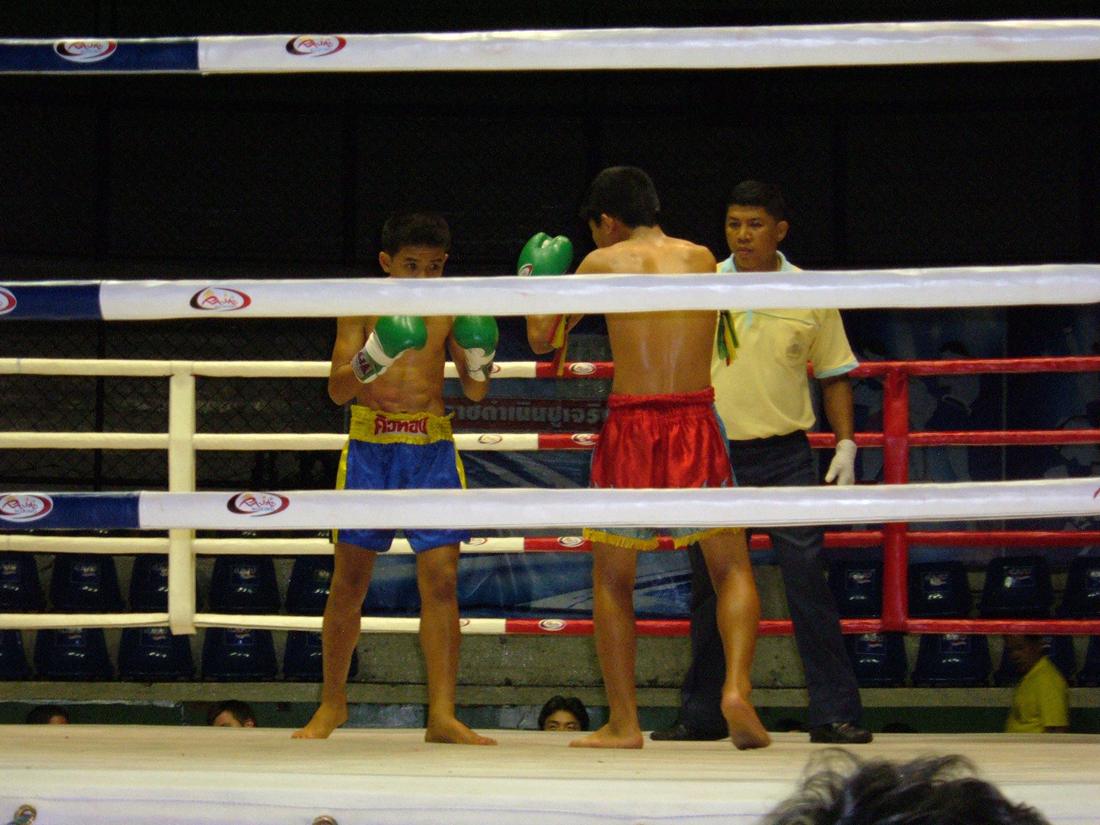 BrokenSphere · CC BY 3.0
What it is
Three judges, five rounds, one decision. Everything else about it is different from boxing, and the differences are what make a visitor think the scoring is broken.
The long version
Tradition — stadium scoring in Thailand is not that, and is not written down anywhere a visitor can read it. What follows is how it is described by people inside the sport, and this project marks it as tradition rather than citing a rulebook it has not got.
The fight is scored as one thing. Rounds one and two are treated as assessment and are frequently scored even by all three judges. The decision is made in rounds three, four and five, and a fighter who was behind after two has lost nothing.
Effect beats volume. A kick that folds a man scores; six punches that do not move him score nothing. Being knocked off balance, dumped or visibly hurt is what a judge is watching for.
Kicks and knees outrank punches and elbows. Not because they are harder — an elbow ends more fights — but because the scoring tradition treats them as the art's own weapons.
Walking forward is not scoring. Aggression that lands nothing is read as clumsiness, and the man going backwards while landing is ahead.
Inference — every one of those rules makes sense if you assume the audience is betting, in play, on a five-round arc. You cannot bet on a fight that is decided in round one.
How
The written amateur rule, from IFMA, is narrow: a strike scores if it connects without being blocked, and a strike that lands on a glove, forearm, shin or foot does not score. If the scores are level at the end, the fighter who landed more full-contact blows wins.
Connected to
- The gambling floor Who the rules are shaped around.
- Five rounds of three minutes The shape of the five.
- The fist The weapon this system punishes.
- Muay femur The fighter this system rewards.
- Why you thought he won What it looks like from the cheap seats.
Named here by
- The eight limbs Which of the eight a judge rewards.
- The fist Why it is worth so little.
- The clinch Why the crowd is shouting.
- The dump What it is worth.
- The round kick Why it counts for so much.
- Four ways to win a fight What sorts between them.
- Muay femur The system it is built for.
- Muay mat What it is up against.
- Rodtang Jitmuangnon The rules he does not fight under.
- The gambling floor What it shapes.
- The doctor, and the cut What it overrides.
- Five rounds of three minutes What the five are for.
- Why you thought he won The rules behind it.
- te Why it is what they shout.
Where each claim comes from
| Field | Tier | Source | Note |
|---|---|---|---|
| default | tradition | Muay Thai — Wikipedia (en) | |
| text.how | cited | Muay Thai — Wikipedia (en) | |
| text.story | tradition | described from inside the sport; this project has no rulebook for stadium scoring | |
| text_th | inference | written in Thai by this project, not machine-translated |
Sources
- Muay Thai — Wikipedia (en)
cited Cited — a named source, linked · harvested Harvested — fetched from an open dataset, with its licence · tradition Tradition — general knowledge of the tradition, hedged · inference Inference — this project's own reasoning from the above · field Field — someone stood there