styleThe four lines, and the rhyme that ranks them
สี่สายมวย · si sai muay
Heavy fists Korat · clever Lopburi · good form Chaiya · faster than Thasao
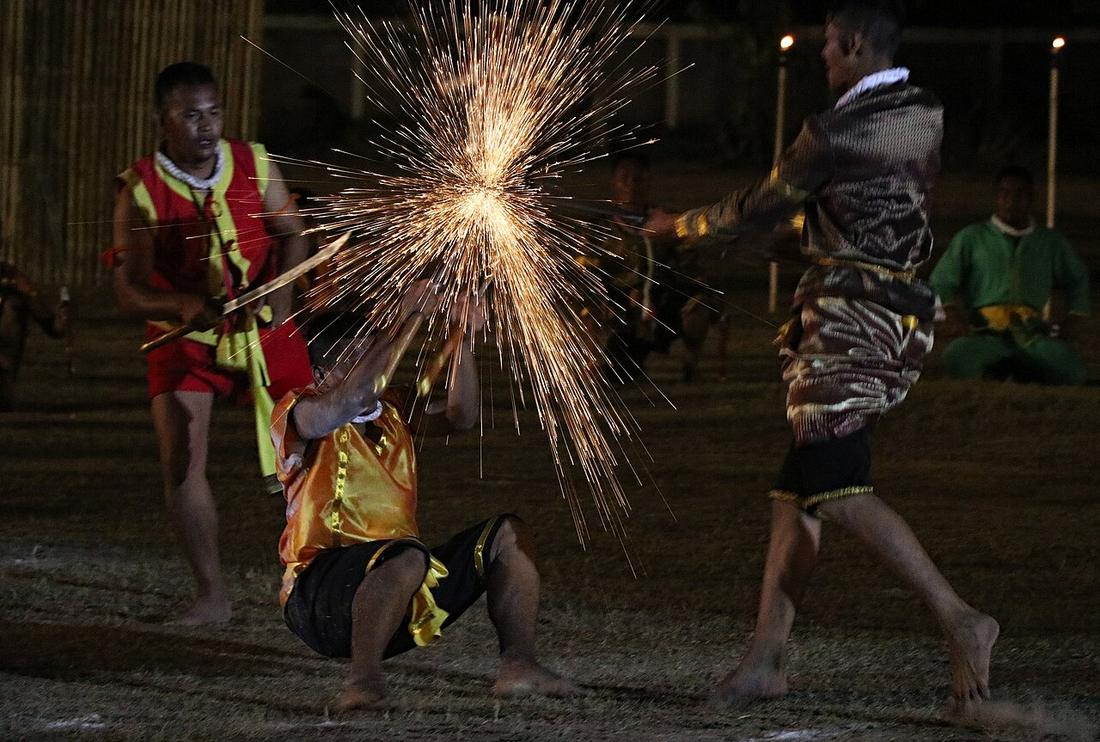 Arjarn Sira · CC BY-SA 4.0
What it is
Four regional schools, each with its own reputation, fixed in a four-part saying that Thai sources still quote first and explain second.
The long version
หมัดหนักโคราช ฉลาดลพบุรี ท่าดีไชยา ไวกว่าท่าเสา — heavy fists from Korat, cleverness from Lopburi, good form from Chaiya, faster than Thasao. Eleven syllables that do the work of a curriculum.
The lines were not tidy regional traditions that someone later noticed. They were named at a funeral. In 1910 Rama V called fighters in from the provinces to fight at the cremation of his son Prince Urubongse, and granted the rank of muen to the three best — from Lopburi, Khorat and Chaiya. The English article says it plainly: those three "would later become codified as regional styles of Muay Boran".
So the four schools are a prize list before they are a taxonomy, and the adjectives in the rhyme are what three individual men did on one afternoon in Bangkok.
Thai Wikipedia now counts seven lines rather than four: the four, plus Muay Phra Nakhon of Ayutthaya, plus the Department of Physical Education's syllabus, plus the army's Muay Thai Loet Rit. Two of the seven are government programmes, which is a fair picture of where the transmission actually sits.
Connected to
- Muay Korat Heavy fists.
- Muay Lopburi Clever.
- Muay Chaiya Good form.
- Muay Thasao Fast.
- Muay boran What the four are collectively called now.
- How old is any of this Who assembled the list, and when.
Named here by
- Muay Chaiya One of the four.
- Muay Korat One of the four.
- Muay Lopburi One of the four.
- Muay boran What it collects.
- Muay Thasao One of the four.
- Rama V, and the making of a national sport What came out of it.
- Lanna The canon it is outside.
- How old is any of this The four schools.
Where each claim comes from
| Field | Tier | Source | Note |
|---|---|---|---|
| default | cited | มวยไทย — Wikipedia (th) | |
| text_th | inference | written in Thai by this project, not machine-translated |
Sources
- มวยไทย — Wikipedia (th)
- Muay Thai — Wikipedia (en)
- แม่ไม้มวยไทย — the fifteen and the fifteen, at revision 13177866 — Wikipedia (th)
cited Cited — a named source, linked · harvested Harvested — fetched from an open dataset, with its licence · tradition Tradition — general knowledge of the tradition, hedged · inference Inference — this project's own reasoning from the above · field Field — someone stood there