storyWhy the moat runs one way
ทำไมรอบคูเมืองวิ่งทางเดียว
Outer bank clockwise, inner counter, and a missed turn costs 6.54 km.
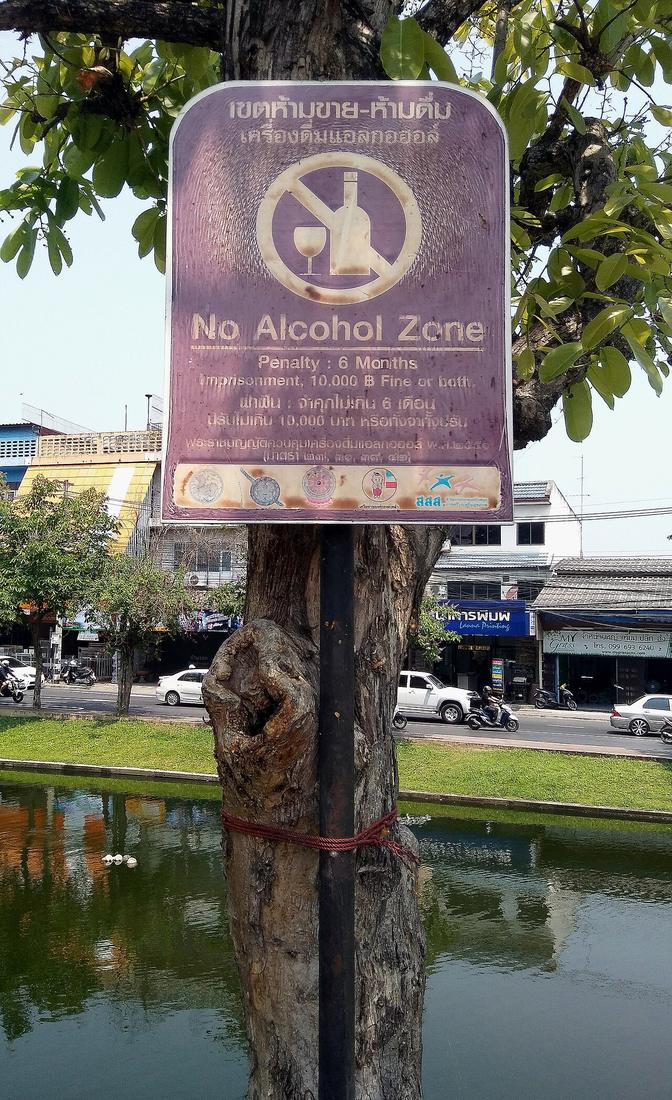 Hartmann Linge · CC BY-SA 4.0
What it is
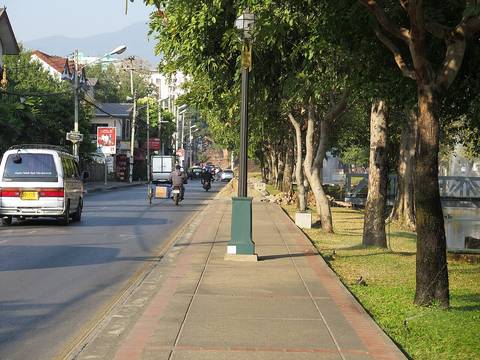
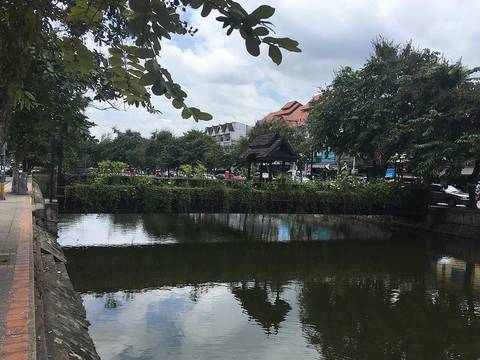
The pair of roads the municipality built on the moat's banks in 1948 run as two one-way loops in opposite directions. The year the one-way system began is not on this disk; the fact of it is on Thai Wikipedia and on every windscreen in the city.
The long version
Inference — a moat 13 m wide with a road on each bank cannot carry two-way traffic on either without a lane of parking going, and the banks are where the city parks. One-way doubled the capacity of both roads for the price of some U-turns at the corners. The corners are the four chaeng, and the U-turn slots there are the busiest fifty metres of road in the old city.
Inference — the cost is paid by anyone who does not know the square. A visitor aiming for Tha Phae Gate from the inside and missing the cut through drives to Katam Corner, round the south, up the west, along the north, and arrives 5 km later at the place they could see when they left. The measurements page's one-way share for the moat zone is the number that describes this.
The walkable-district pilot of 2021 made Ratchadamnoen one-way inside the square too, which is the same logic applied for the opposite reason: not to move cars faster but to make room for people.
Connected to
- The moat loop The loop.
- Ratchadamnoen Road The inside one-way.
- Katam Corner Where the missed turn is paid for.
- How much of the road runs one way The number.
Named here by
- The moat loop The argument.
- How much of the road runs one way The argument.
Where each claim comes from
| Field | Tier | Source | Note |
|---|---|---|---|
| default | inference | คูเมืองเชียงใหม่ / กำแพงเมืองเชียงใหม่ — Wikipedia (th) | |
| text_th | inference | written in Thai by this project, in the northern register where it fits; not machine-translated |
Sources
- คูเมืองเชียงใหม่ / กำแพงเมืองเชียงใหม่ — Wikipedia (th)
- ราชดำเนินเดินรถทางเดียว 6 พ.ค. 2564 — เตียว-หย้อง-เมืองเชียงใหม่ — Chiang Mai News
- Chiang Mai City history timeline — City Heritage Centre, Chiang Mai Municipality
cited Cited — a named source, linked · harvested Harvested — fetched from an open dataset, with its licence · tradition Tradition — general knowledge of the tradition, hedged · inference Inference — this project's own reasoning from the above · field Field — someone stood there