
Yi Peng · Chiang Mai
Khom Loi, Drawn
Paper, a bamboo hoop, a ring of fuel and a little fire. Why it goes up, how high, for how long, and where it comes down: every lantern on this page flies by the same sums.
Tap the sky to send one up.
Why it rises, how high it flies, where it lands
motdang.net/sites/khom-loi
What it is
Paper, a hoop and a ball of fire
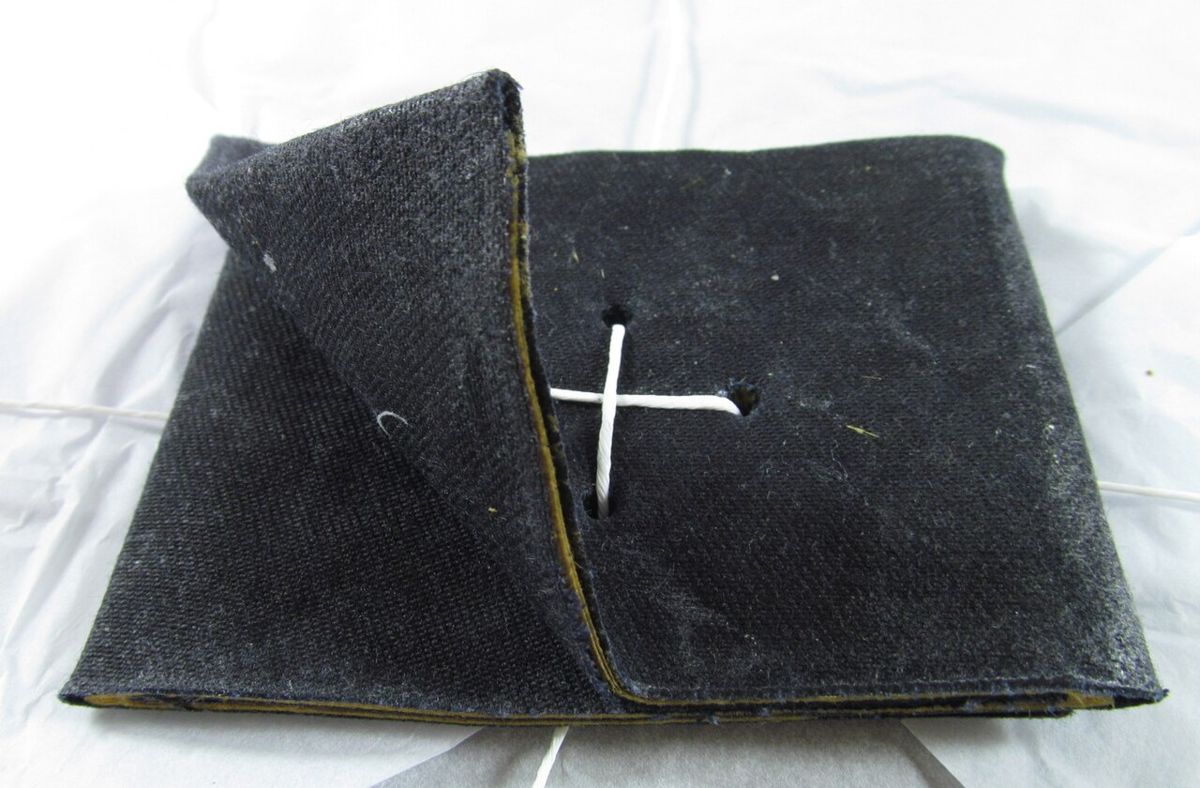
A khom loi is a paper drum, closed at the top and open at the bottom, on a hoop of bamboo. Two wires cross the hoop and hold the fuel in the middle: paper or cloth soaked in wax or paraffin. A Lanna description calls the burning part the luk fai, ลูกไฟ, the ball of fire, and says it was once cast from khi ya and is now toilet paper soaked in candle wax.
Thai provincial notices set the most it can be: 90 cm across, 140 cm tall, one cubic metre inside, natural materials, and at most 55 g of fuel burning for at most 8 minutes. Bigger than that, it counts as an aircraft. Chiang Mai uses the same limits.
In Lanna the word is waao, ว่าว. Yi Peng had two kinds: waao hom, ว่าวฮม, filled with smoke and let go by day, and waao fai, ว่าวไฟ, which carries fire and goes up at night. The night one is what most people now call khom loi; the airport's notices call the day one โคมควัน, khom khwan, the smoke lantern.
Yi Peng is the full moon of the second Lanna month, the same night as the full moon of the twelfth month in central Thailand, Loy Krathong. The government's public relations department writes that the lanterns honour Phra Ket Kaew Chulamani, the Buddha's hair relic in Tavatimsa heaven, and carry sorrow and bad luck away.
night airhot air inside
Why it rises
Hot air is thin air
Air is tiny bits bumping around. Heat them and they bump harder and spread out, so the same space holds fewer of them. A lantern full of hot air holds less air, by weight, than the same space of cool night air.
The lantern goes up when the night air it pushes aside weighs more than the hot air inside plus the paper, the hoop and the fuel. The difference is the lift.
lift = V × (ρnight − ρinside) ρ = p ÷ (R × T)
Hotter than about 230 °C, paper starts to char. In TU Delft's tests one lantern's top caught fire 105 seconds after lighting, with its fuel still burning.
The lantern drawn here is a paper drum, 62% as wide at the mouth as it is tall and a little wider at the top: 22 g/m² paper, a 12 g hoop, 30 g of fuel. T in the sum is in kelvin, °C + 273; p is 96.5 kPa, the air pressure Chiang Mai University's physics lab measured; R is 287 J/(kg·K) for air. That lab lifted a 28.7 g lantern of 0.159 m³ with a tealight in 2022. The same sum says it needs 85.6 °C inside at the lab's 27.65 °C; they worked out 85.8 °C and measured 95.0 °C with an infrared camera.
One flight
Up while it burns, down when it cools
Light the fuel and hold on. The air inside warms until the lantern tugs at your hands, and then you let go. It climbs while the fuel burns. When the fuel is gone the air inside cools in under a minute and the lantern comes down.
heightinside temperaturefuel burning
Every quarter of a second the page works out four things: how much fuel burned, how much of its heat stayed in the air inside, how hard the night air pushes up, and how fast the lantern moves against the drag of the air. Twice the fuel flies about twice as long. A smaller lantern with the same fire runs hotter inside.
This flight is the page's own model, built the way TU Delft's 2017 sky-lantern model is: lift from the difference in air density, air thinning with height, fuel burning down at a steady rate, then a fall at the speed where drag matches weight. The burn rate comes from TU Delft's timed burns (100–330 s) and the 55 g, 8 minute legal limit. The share of heat kept inside and the heat lost through the paper are tuned guesses. For comparison, Dutch inspectors watched ten lanterns in 2009: 2 to 5 minutes up, 50 to 300 m high, landing 633 to 1,900 m away.
Where it lands
The wind decides
A lantern has no steering. It goes where the air goes, and the air higher up moves faster than the air by the river. Here are forty lanterns from one place, each a little different. The big ticketed releases are out near Mae Jo in San Sai.
came down on landin wateron the airport
All of Mueang Chiang Mai and Hang Dong, and parts of Saraphi, San Sai, Mae Rim and San Pa Tong, are closed to lanterns at Loy Krathong: 39 sub-districts in 6 districts. Tha Phae Gate is on this map to show why: the runway is 3.3 km away as the crow flies. A light wind from the east and a few minutes in the air are enough.
The airport has counted the lanterns that came down inside its fence: 1,425 in 2013, 142 in 2014 and 59 in 2015.
Map: OpenStreetMap contributors (ODbL). The wind grows with height as (height ÷ 10 m)0.25, a usual shape on a calm night. Each lantern gets its own size, fuel and gust, and a wind up to 20° off the one you set.
A thousand lanterns
How many are up at once
Let lanterns go at a steady rate and the sky fills, until the first ones start coming down. From then on the count holds: lanterns let go each minute times the minutes each one flies.
Shops use the same sum, called Little's law: people in the shop = people coming in each minute × minutes each one stays.
up at once = λ × W
W comes from the one-flight model above: a 1 m lantern, 30 g of fuel.
Yi Peng 2026
Two nights, set hours
The full moon is Tuesday 24 November 2026 at 21:53 Chiang Mai time. The Civil Aviation Authority's notice for Chiang Mai and Lamphun, published 23 July 2026, sets the hours for lanterns:
In those hours Chiang Mai airport stops flying. In 2025 it cancelled 65 flights and retimed 96 over two nights; in 2023 it cancelled 101 and retimed 59.
A release needs a permit from the district chief, asked for at least 30 days ahead. Chiang Mai approved about 62,000 lanterns in 2024; requests for 2025 came to 92,313. Launching near an airport against the Air Navigation Act carries up to 5 years in prison and a 200,000 baht fine.
Chiang Mai province had not posted its 2026 notice by 3 October 2026. In past years it came out in October or November.
 Krathong, Drawn The same night on the river: folding the leaf, floating, and where the current takes it.
Pictures
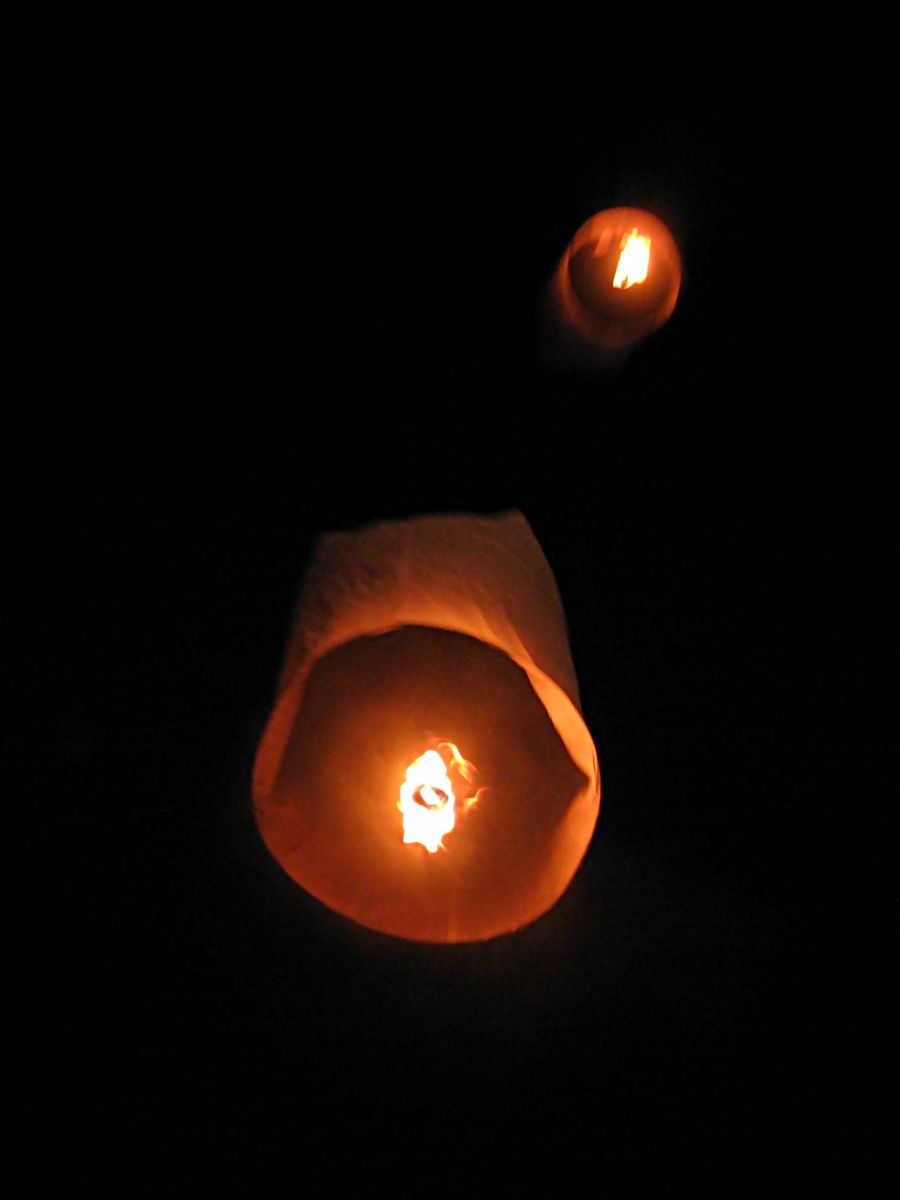
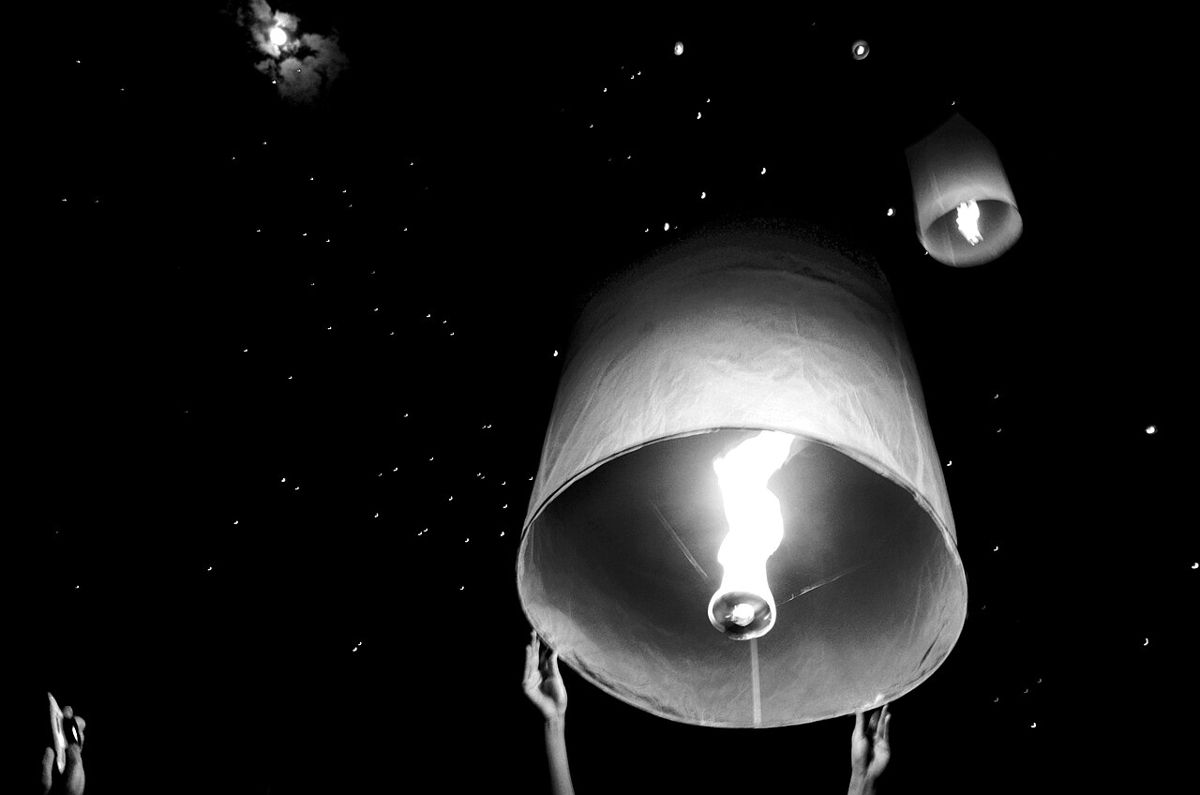
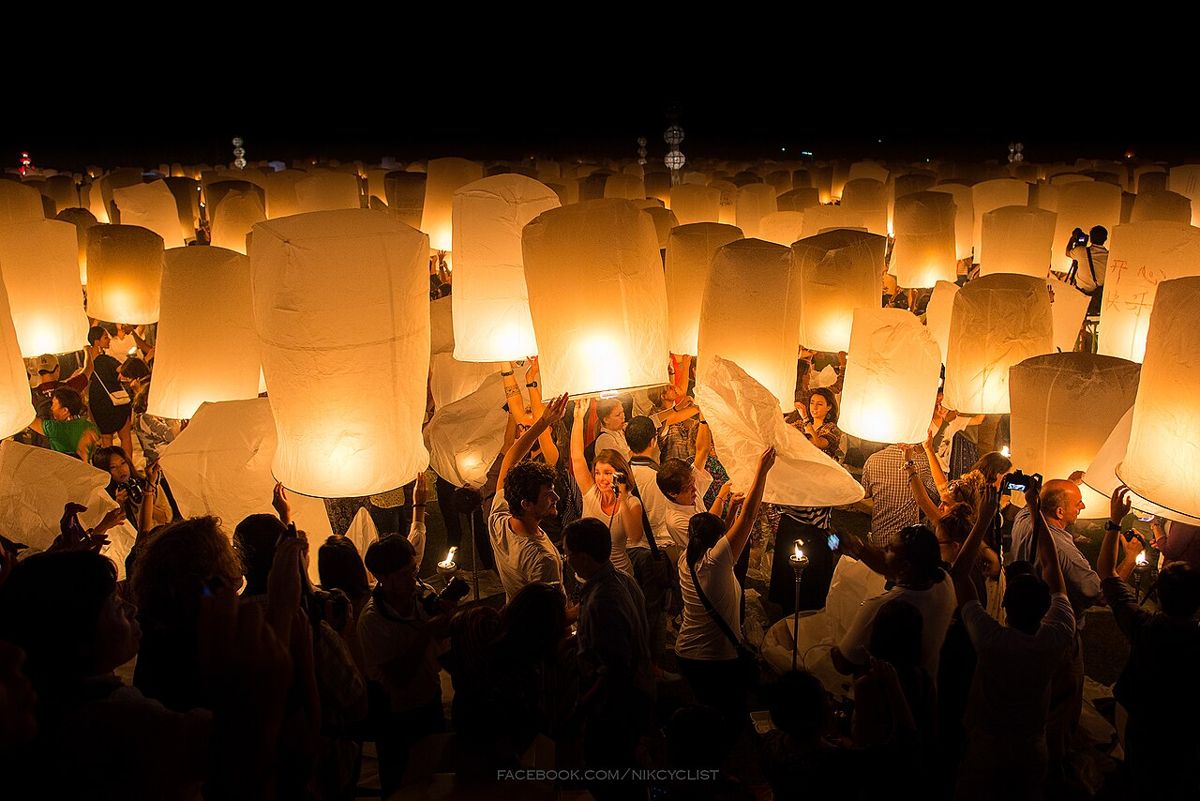
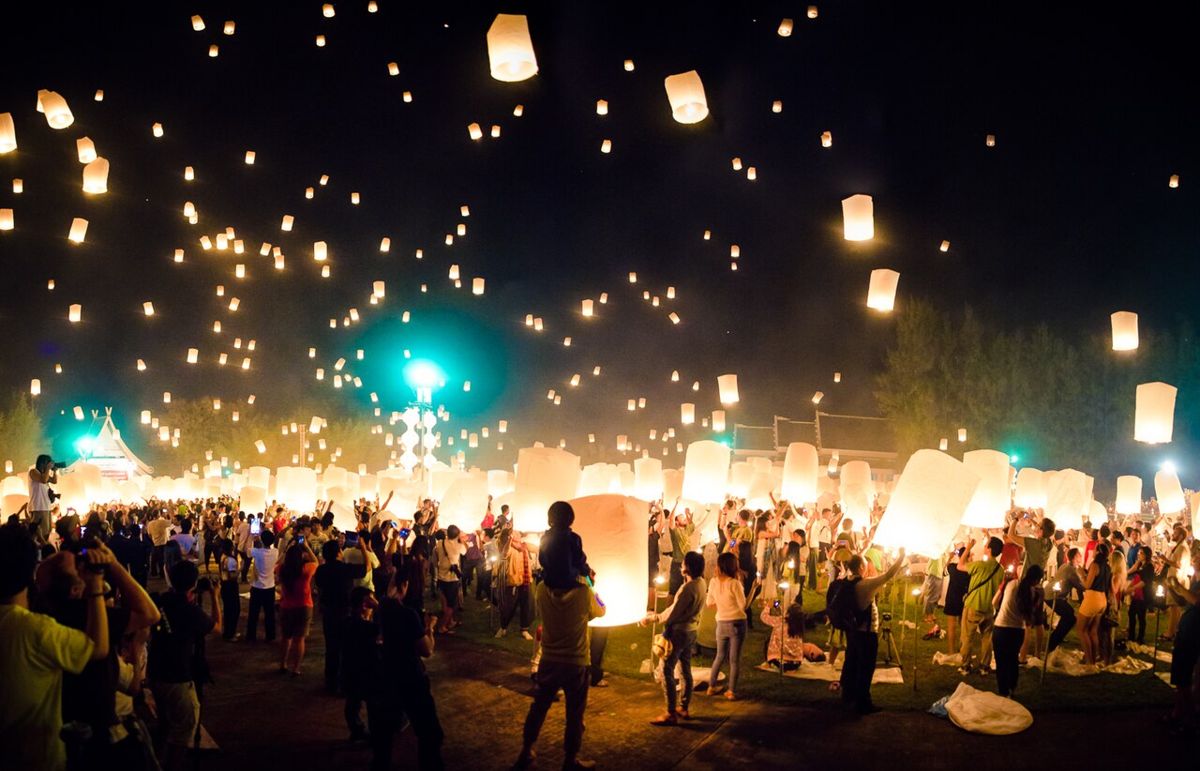
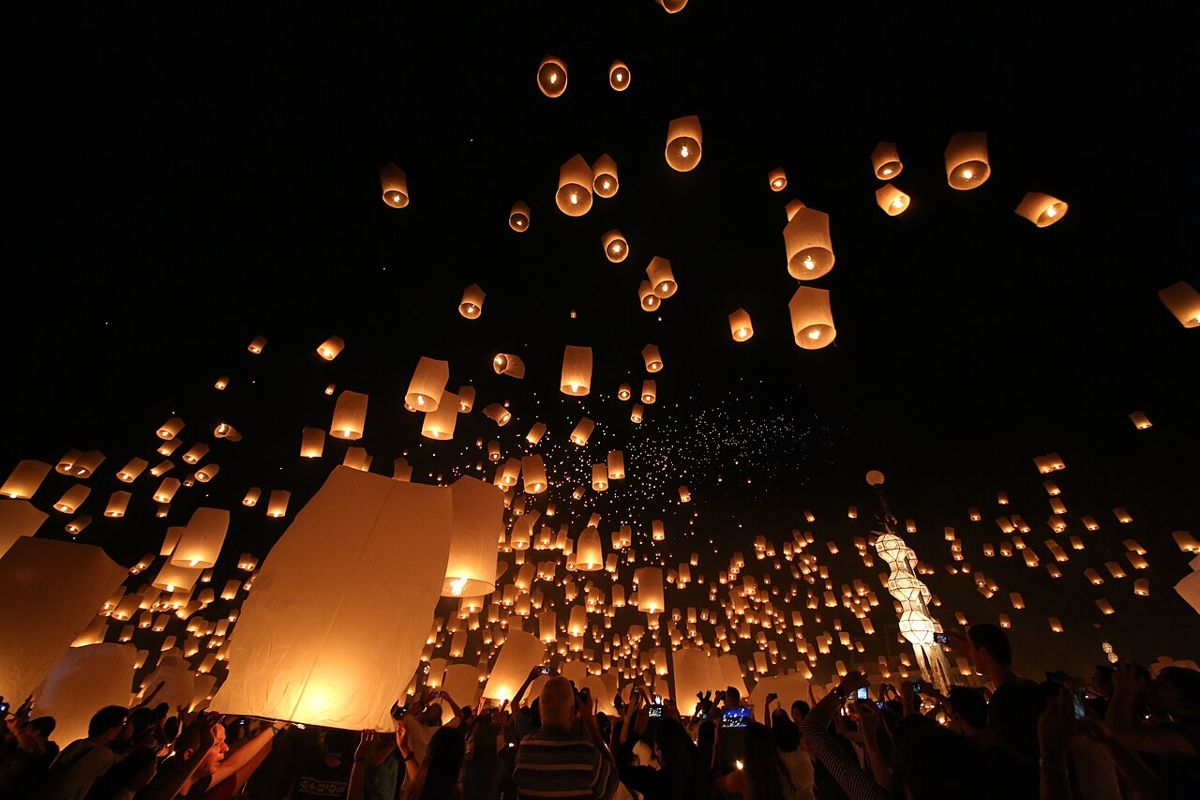
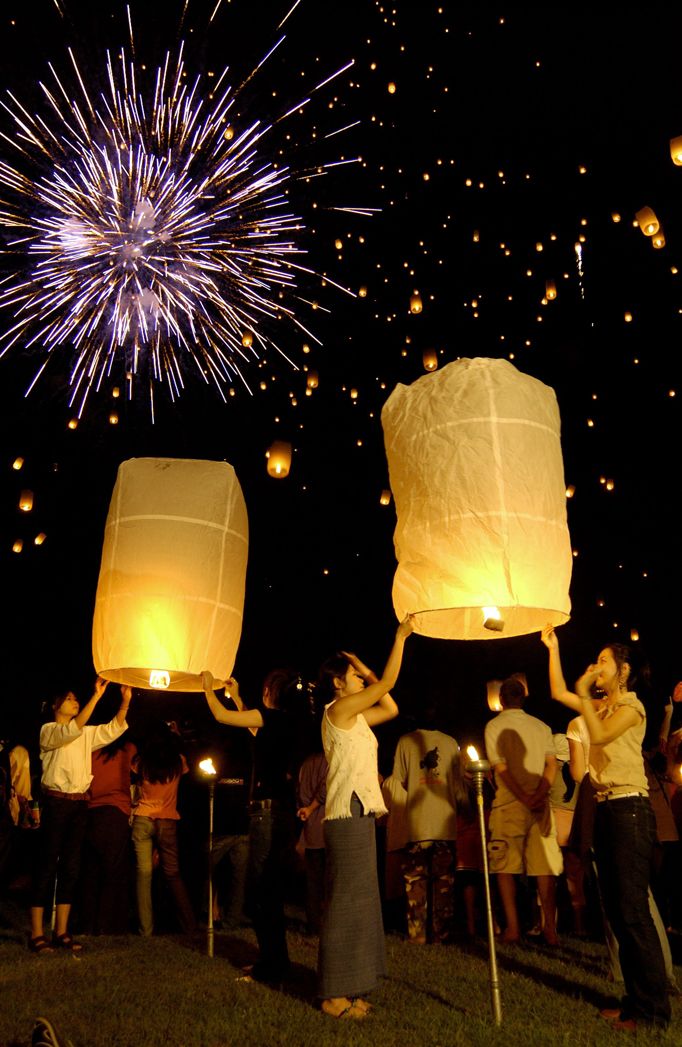
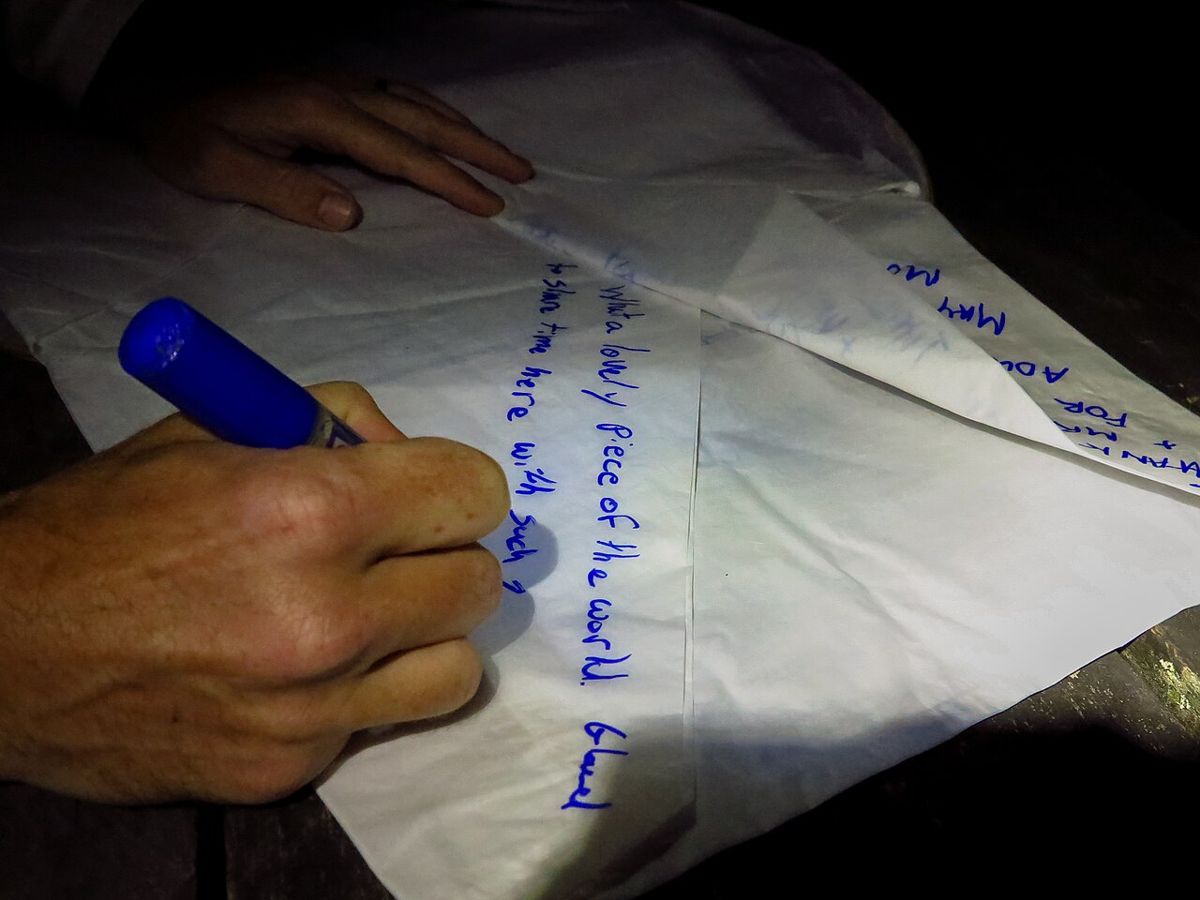
Lanterns and the people who let them go



.jpg)
.jpg)


_(31987951110).jpg)

Words
floating lantern, the night one that carries fire
full moon of the second Lanna month
Lanna: the fire lantern, let go at night
Lanna: the smoke lantern, let go by day
smoke lantern, today's word for waao hom
the ball of fire: the fuel
fuel, the word the notices use
to let a lantern go
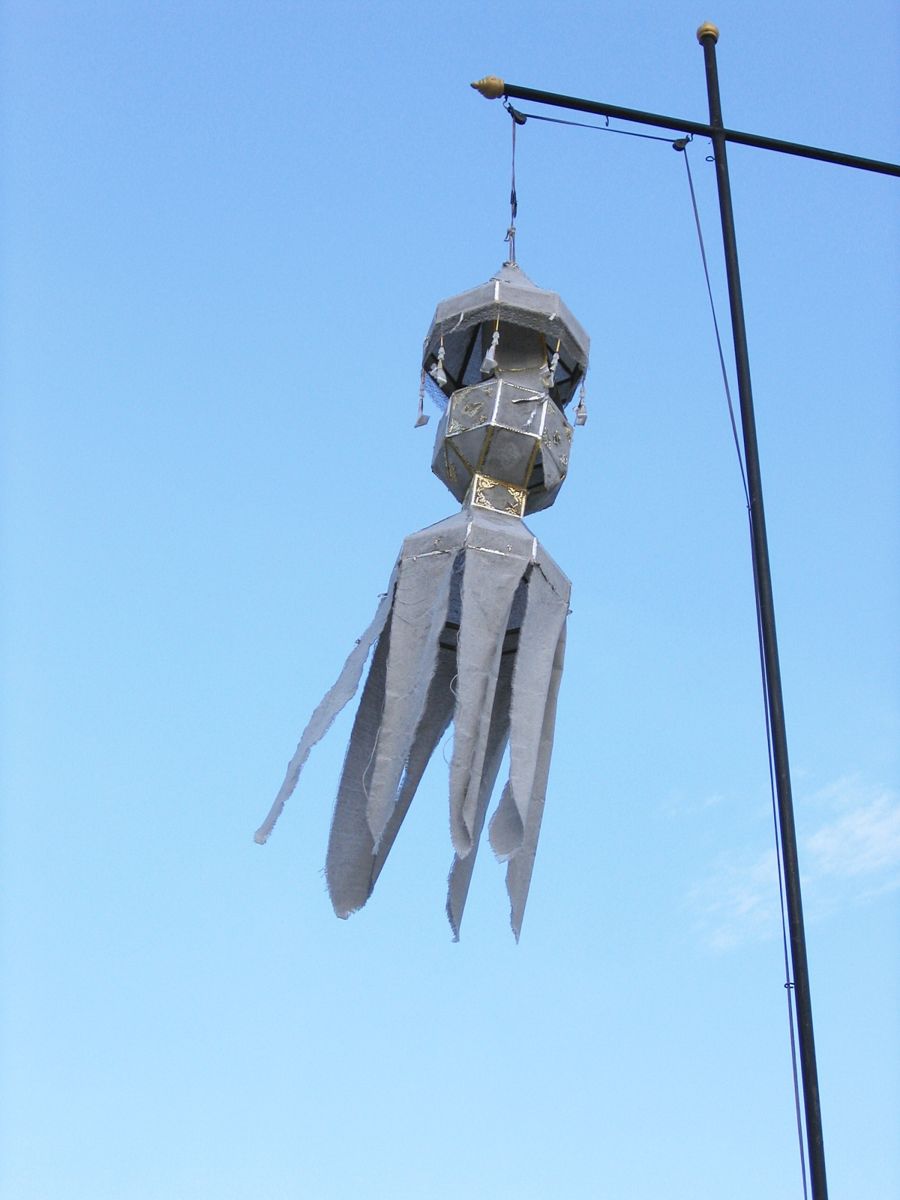
hanging lantern, stays on its pole
turning lantern, spun by its own flame's heat
small clay lamps lit for Yi Peng
the Buddha's hair relic in Tavatimsa heaven
Sources
Where the facts on this page come from.
- Royal Gazette, Samut Sakhon province notice on lanterns (size and fuel limits), 14 Nov 2016
- MGR Online, Chiang Mai lantern limits and banned districts, 18 Oct 2023
- Civil Aviation Authority of Thailand, AIP SUP A 27/26, Chiang Mai lantern hours, 24–25 Nov 2026
- US Naval Observatory, moon phases 2026
- Wattanakasiwich, Kongkhumbod & Pussadee, Heating up a lantern with a tealight candle, Revista Mexicana de Física E 19, 2022 (Chiang Mai University)
- Schuurman & Gransden, Sky Lantern Safety Flight Profile for Risk Assessment, AIAA 2017-3289 (TU Delft)
- TU Delft Aerospace Engineering, Fiery romance: a risk model for sky lanterns
- Payap University Library, ประเพณียี่เป็ง (Lanna custom sheet)
- กรมประชาสัมพันธ์ (Government Public Relations Department), ยี่เป็ง, 13 Jun 2026
- ศิลปวัฒนธรรม, why Lanna's second month is central Thailand's twelfth, 11 Nov 2019
- Airports of Thailand, press release 89/2567 on lanterns and the Air Navigation Act, 11 Nov 2024
- Thai PBS, Chiang Mai approves 62,000 lanterns, 12 Nov 2024
- Prachachat Turakij, Yi Peng 2025 figures, 23 Nov 2025
- Thansettakij, Chiang Mai airport flight changes for Yi Peng 2025, 1 Nov 2025
- The Nation via Asia News Network, 160 Chiang Mai flights cancelled or rescheduled, 24 Nov 2023
- Matichon, lanterns collected inside Chiang Mai airport 2013–2015, 9 Nov 2016
- OpenStreetMap contributors (ODbL), map data via Protomaps